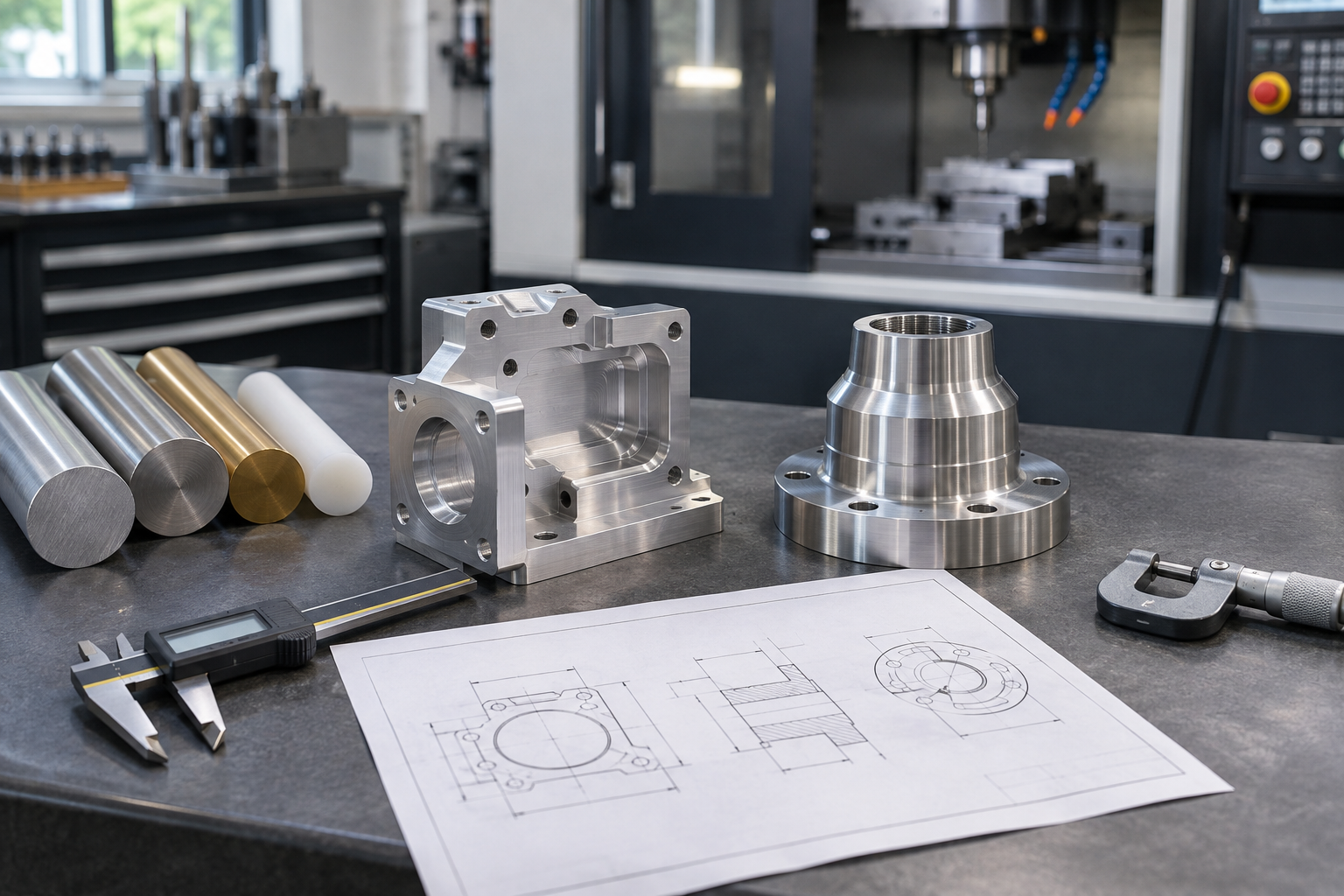
A useful CNC machining cost estimate is not based on part size alone. A supplier must review the material, geometry, machining access, tolerances, quantity, finishing, inspection and delivery requirements before building a reliable process plan.
This guide explains the main factors behind a custom CNC machining quote. It does not provide a universal price list because two parts with similar dimensions can require very different machines, setups, tools and inspection methods.
Quick Answer: What Determines CNC Machining Cost?
CNC machining cost is usually influenced by nine connected factors:
- Material grade and stock size
- Part geometry and material removal
- Number of setups and machining access
- Tolerances and geometric requirements
- Order quantity
- Tooling and special features
- Surface finish and secondary operations
- Inspection and documentation
- Packaging, delivery and commercial requirements
The drawing and 3D model determine how these factors interact. For a project-specific review, send the controlled files and required quantity rather than relying on a general price-per-hour comparison.
1. Material Grade and Stock Size
The material description should include the exact grade and condition. “Aluminum,” “stainless steel,” or “plastic” is not specific enough for a firm quotation.
Material affects more than the purchase price. Different grades can change cutting speed, tool wear, heat generation, chip control and the risk of distortion. The stock form also matters. A part may start from plate, bar, tube, extrusion or a near-net blank depending on geometry and availability.
Provide details such as:
- Exact alloy or plastic grade
- Temper, condition or hardness when applicable
- Required material certificate or traceability
- Color for engineering plastics
- Approved alternatives, if any
See our CNC machining materials and surface finishes page for common material options.
2. Part Geometry and Material Removal
Geometry determines the machining route and the amount of work required to convert raw stock into the finished component.
Deep pockets, thin walls, small internal radii, long-reach features and complex contours may require smaller tools, additional passes or more careful cutting conditions. A part that removes a large percentage of the starting stock can also require more machine time than a compact shape with similar finished dimensions.
Useful design questions include:
- Can the tool reach every required feature?
- Are internal corner radii compatible with practical cutter sizes?
- Are deep cavities or thin sections functionally necessary?
- Can a standard stock size reduce excess material?
- Does the part suit CNC milling, CNC turning, or a combination of processes?
The goal is not to simplify every part. It is to distinguish functional geometry from details that add manufacturing effort without improving performance.
3. Setups, Workholding and Machining Access
Each setup requires the part to be located, clamped, aligned and verified. Features on several faces may therefore increase programming, workholding and handling requirements.
Simple parts may be completed with a straightforward vise, chuck or soft-jaw arrangement. Irregular, thin or delicate components can require dedicated fixtures or additional support to control movement and distortion.
When possible, identify which faces, datums and features are functionally related. This helps the supplier plan a process that protects alignment between critical features.
Review our equipment and capacity page when comparing part size and machining access with available equipment. For process selection and setup trade-offs, read our 3-axis vs 5-axis CNC machining guide.
4. Tolerances and Geometric Requirements
Tolerances should reflect how the part fits, moves, seals or aligns in the final assembly. Applying tight tolerances to every dimension can increase machining and inspection work without adding functional value.
Critical requirements may affect:
- Toolpath strategy and cutting parameters
- Number of roughing and finishing passes
- Temperature control and process stability
- In-process measurement
- Final inspection method
- Scrap and rework risk
Mark the dimensions that are truly critical. Include datums, fits, positional requirements and geometric tolerances where they are needed. If a general tolerance standard applies, identify it on the drawing.
Read more about CNC machining tolerances and inspection.
5. Prototype and Production Quantities
Order quantity changes how one-time work is distributed across the parts. Programming, setup and fixture preparation may represent a larger share of a prototype order than a repeat batch.
For a clearer comparison, request prices for the quantities that are actually relevant to the project. For example:
- Prototype quantity for design verification
- Initial production quantity
- Expected repeat quantity per release
Do not present a large forecast as a confirmed order. Instead, distinguish the current requirement from possible future demand. This allows the supplier to review the appropriate process without creating a misleading commercial assumption.
For repeat but limited quantities, see our small-batch CNC machining service information.
6. Tooling, Threads and Special Features
Standard holes, threads, radii and profiles can often be produced with existing tooling. Unusual forms, deep small-diameter holes, long threads, undercuts or special surface requirements may need dedicated tools or a different process sequence.
The drawing should clearly state:
- Thread standard, size, pitch and required depth
- Difference between thread depth and drilled depth
- Insert or supplied-hardware requirements
- Undercut, groove or special-profile dimensions
- Edge-break or radius requirements that affect function
Complete callouts reduce uncertainty during quotation and help prevent different suppliers from pricing different interpretations.
7. Surface Finish and Secondary Operations
The quote must distinguish between an as-machined part and a part that requires polishing, anodizing, passivation, plating, powder coating, bead blasting, heat treatment or another secondary process.
Specify the finish, applicable standard, color, cosmetic surfaces and masking requirements. If appearance is important, define the acceptance criteria rather than relying only on a finish name.
Secondary operations can also change the machining plan. Allowance may be needed for coating thickness, distortion, post-treatment grinding or protection of threaded and mating features.
8. Inspection and Documentation
Inspection scope should match the drawing and purchasing requirements. A standard dimensional check is different from a documented first article, full dimensional report, CMM program, material certificate or surface-treatment record.
State the required deliverables in the RFQ:
- Critical-dimension inspection report
- First article inspection
- CMM inspection for suitable features
- Material or treatment documentation
- Lot, serial or part identification
- Sampling plan or full inspection requirement
Do not assume that every document is automatically included. Clear requirements allow the supplier to confirm availability and include the necessary work in the quotation.
9. Packaging, Delivery and Commercial Scope
The finished-part price and the delivered project cost are not always the same. Packaging, corrosion protection, destination, shipping method, delivery date and trade terms can affect the final commercial scope.
Provide the destination country or postal code and identify whether the requested date is preferred or firm. If parts need individual protection, clean-room packaging, labels or special handling, include those requirements before the quote is finalized.
How to Compare CNC Machining Quotes Fairly
Two quotations are comparable only when they cover the same technical and commercial scope.
| Check | Confirm before comparing prices |
|---|---|
| Files | Same part number, drawing revision and CAD model |
| Material | Same grade, condition, stock assumptions and documentation |
| Quantity | Same order quantity and repeat-order assumptions |
| Tolerances | Same general and feature-specific requirements |
| Finishing | Same treatment, color, masking and cosmetic scope |
| Inspection | Same reports, certificates and sampling requirements |
| Hardware | Same inserts, supplied parts and assembly work |
| Delivery | Same destination, packaging, freight and requested date |
A lower number may reflect a different scope rather than a more efficient process. Ask the supplier to identify exclusions and technical assumptions when the difference is unclear.
How to Reduce Unnecessary CNC Machining Cost
Cost reduction should preserve the function of the component. Practical review points include:
- Apply tight tolerances only to functional features
- Use standard material grades and stock sizes when suitable
- Increase internal radii where the design allows
- Avoid unnecessary deep pockets and long-reach features
- Reduce the number of required setups when possible
- Separate cosmetic surfaces from non-cosmetic surfaces
- Specify only the inspection records the project requires
- Request realistic prototype and production quantities
- Keep drawing and CAD revisions controlled
A supplier may be able to suggest a different machining route, workholding strategy or feature detail after reviewing the complete files. Any proposed change should be approved before production.
Frequently Asked Questions
Can CNC machining cost be estimated without a drawing?
A rough discussion may be possible from a clear model and project description, but a controlled drawing is recommended when the part includes critical tolerances, threads, datums, surface requirements or inspection notes.
Why does a prototype cost more per part?
Programming, setup, workholding and process verification are required before the first acceptable part is completed. In a small quantity, those one-time activities are distributed across fewer components.
Does a tighter tolerance always increase cost?
Not every tolerance changes the process in the same way. Cost impact depends on the feature, material, size, geometry, measurement method and relationship to other requirements. Mark critical tolerances clearly so the supplier can review them individually.
Should I ask for an hourly machine rate?
An hourly rate alone does not show the complete project cost. A suitable machine with an efficient setup may produce a lower finished-part cost even if its nominal rate is higher. Compare the full scope, assumptions and delivered result.
Prepare Your CNC Machining RFQ
Use the downloadable CNC Machining RFQ Checklist to organize the drawing, CAD file, material, quantity, tolerances, finish, inspection and delivery information.
When the project files are ready, request a CNC machining quote from SYD Precision for technical review.