POM vs nylon CNC machining is a common engineering-plastic decision for custom parts. Both materials can be used for bushings, guides, spacers, rollers, fixtures and custom mechanical components, but they do not respond to moisture, load and temperature in the same way.
The right choice starts with the operating environment and the dimensions that matter to the assembly. This guide compares POM and nylon from a drawing, machining and quotation perspective. For other grades, review our engineering plastic CNC machining service and materials center.
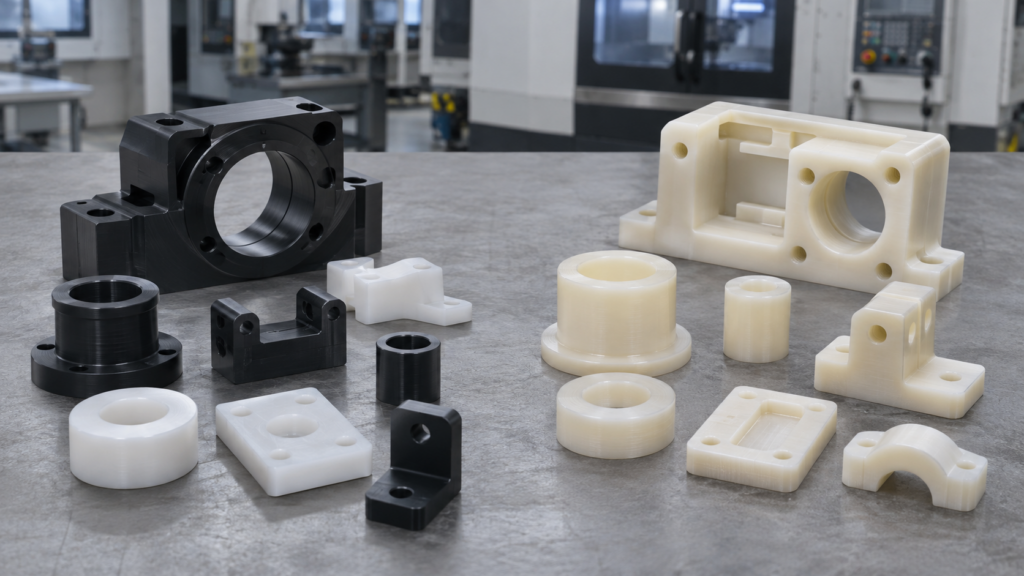
POM vs nylon CNC machining: the short answer
POM, also called acetal, is often the stronger starting point when low moisture absorption, dimensional stability, stiffness and smooth sliding behavior are priorities. Nylon is often considered when toughness, abrasion resistance or impact behavior matters, but its moisture condition must be included in the design and inspection plan.
Neither name is a complete material specification. POM-H and POM-C differ, while nylon includes PA6, PA66 and many filled or modified grades. State the exact grade, color, filler, supplied condition and governing standard on the drawing.
| Selection factor | POM / acetal | Nylon / polyamide |
|---|---|---|
| Dimensional stability in humidity | Usually the more stable starting point because moisture absorption is relatively low | Moisture conditioning can change dimensions and mechanical behavior |
| Sliding and wear | Good sliding properties and wear resistance; grade still matters | Often selected for wear and toughness; confirm the specific grade |
| Stiffness and precision features | Commonly considered for precise bores, guides and low-friction components | Dry and conditioned properties can differ, so inspection condition matters |
| Impact and toughness | Good general mechanical performance | Frequently considered where toughness or impact behavior is important |
| Drawing requirement | Specify POM-H or POM-C, color and any compliance requirement | Specify PA6, PA66 or another exact grade, filler and conditioning requirement |
When POM may be the better choice
POM combines rigidity, good machinability, low moisture absorption and favorable sliding behavior. It is therefore often reviewed for dimensionally sensitive bushings, bearing surfaces, guides, rollers, valve components, fixtures and electrical-insulating parts.
Low moisture absorption does not remove the need for a complete drawing. Wall thickness, residual stress in the stock, temperature during machining, clamping pressure and part geometry can still influence the finished component. Identify critical bores, flatness, fits and inspection conditions rather than applying one tight tolerance to every feature.
POM-H and POM-C are not identical
POM homopolymer and copolymer have different property profiles. Do not approve a substitution only because both are called acetal. The drawing or purchase specification should identify the required family, grade, color, certification and any contact or regulatory requirement.
When nylon may be the better choice
Nylon grades are widely considered for components that need toughness, abrasion resistance, mechanical strength or repeated sliding contact. Typical design reviews may include gears, rollers, wear pads, guides, spacers and structural plastic components.
The important difference is moisture. Polyamides absorb moisture from the environment, and the resulting conditioned state can influence dimensions and mechanical properties. A drawing should therefore state the expected operating environment and whether dimensions apply to dry, conditioned or service-state parts.
PA6, PA66 and filled nylon grades
“Nylon” alone is too broad for a reliable quote. PA6 and PA66 are different materials, and glass-filled, oil-filled or other modified grades can behave differently during machining and service. Specify the full commercial grade or an accepted material standard. Also identify fillers, color and any certificate or traceability requirement.
Moisture, conditioning and CNC tolerances
Moisture is one of the most important reasons not to copy metal tolerances directly onto a plastic part. Nylon dimensions can change as the material approaches equilibrium with the surrounding humidity. POM is generally less sensitive, but temperature and stock stress still matter.
Mark only the dimensions needed for fit and function. State the inspection temperature, conditioning requirement and mating-part relationship when they affect acceptance. Our CNC machining tolerance and inspection guide explains how to separate critical features from general dimensions.
POM vs nylon CNC machining considerations
- Stock condition: identify the grade, manufacturer requirement and any annealed or conditioned state.
- Heat control: plastic can soften or distort if cutting heat is not controlled.
- Workholding: excessive clamping pressure can deform thin walls, bores and flexible features.
- Tool access: deep pockets, small internal radii and long tools affect stability and surface quality.
- Edge requirements: state acceptable burrs, edge breaks and cosmetic zones.
- Inspection timing: agree when and under what environmental condition the part will be measured.
The final machining route depends on the exact stock, geometry, tolerances and quantity. A process that works for one POM or nylon part should not be copied automatically to another grade or design.
What to put on a POM or nylon part drawing
- Exact material family and grade, such as POM-C, POM-H, PA6 or PA66
- Color, filler and supplied condition
- 2D drawing and matching 3D model revision
- Quantity and prototype or production purpose
- Critical dimensions, datums, fits and geometric tolerances
- Expected temperature, humidity, chemicals and load
- Surface, edge, appearance and cleanliness requirements
- Inspection condition, reports and material certificates
- Delivery destination and required packaging
Common specification mistakes
Avoid writing only “plastic,” “acetal” or “nylon” on the drawing. Do not assume that black and natural grades are interchangeable, that filled and unfilled stock will machine the same way, or that dimensions measured immediately after machining will remain unchanged in every service environment.
Also avoid unnecessary tight tolerances on every feature. This can increase setup, inspection and rejection risk without improving function. Identify the mating interfaces and let noncritical geometry use an appropriate general tolerance.
POM vs nylon CNC machining FAQ
Is POM always more dimensionally stable than nylon?
POM is generally the lower-moisture-absorption starting point, but the final result still depends on grade, stock condition, geometry, temperature and machining stress. Compare the actual supplier data for the specified grades.
Can nylon parts use metal-part tolerances?
Not automatically. Plastic stiffness, thermal expansion, moisture response and clamping behavior differ from metals. Apply tight tolerances only where function requires them and define the inspection condition.
Can POM replace nylon without changing the drawing?
No substitution should be made without engineering approval. Friction, impact behavior, temperature, moisture response, compliance requirements and mating-part performance can all change.
What information is needed for a quote?
Send the drawing, 3D model, exact grade, quantity, critical tolerances, operating environment, surface requirements, inspection scope and delivery destination. We confirm material and process suitability during quotation.
Material data references
For grade-specific design work, review the selected supplier’s current datasheet. General property guidance is available from Ensinger’s POM material overview and BASF’s polyamide processing guide. Supplier data does not replace the customer drawing or application-specific engineering approval.
Send your engineering plastic drawing for review
SYD Precision reviews custom POM, nylon and other engineering-plastic parts against the supplied drawing and model. Share the exact material, quantity, operating environment, critical dimensions and inspection requirements for a project-specific quotation.